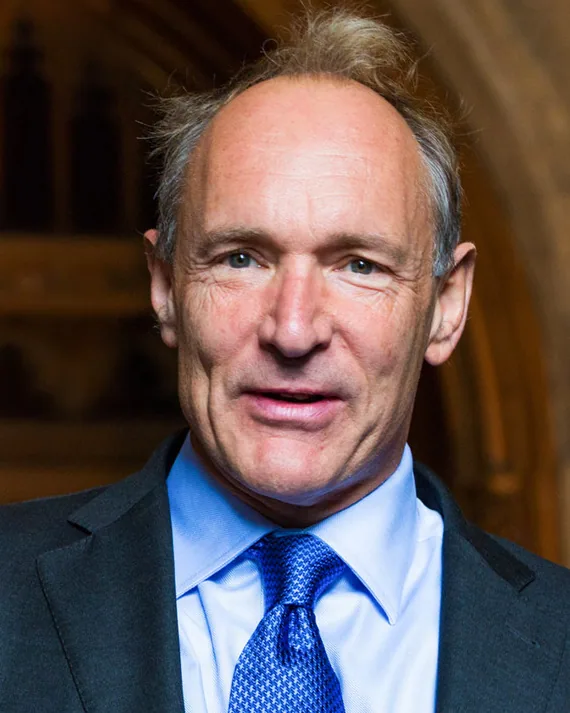
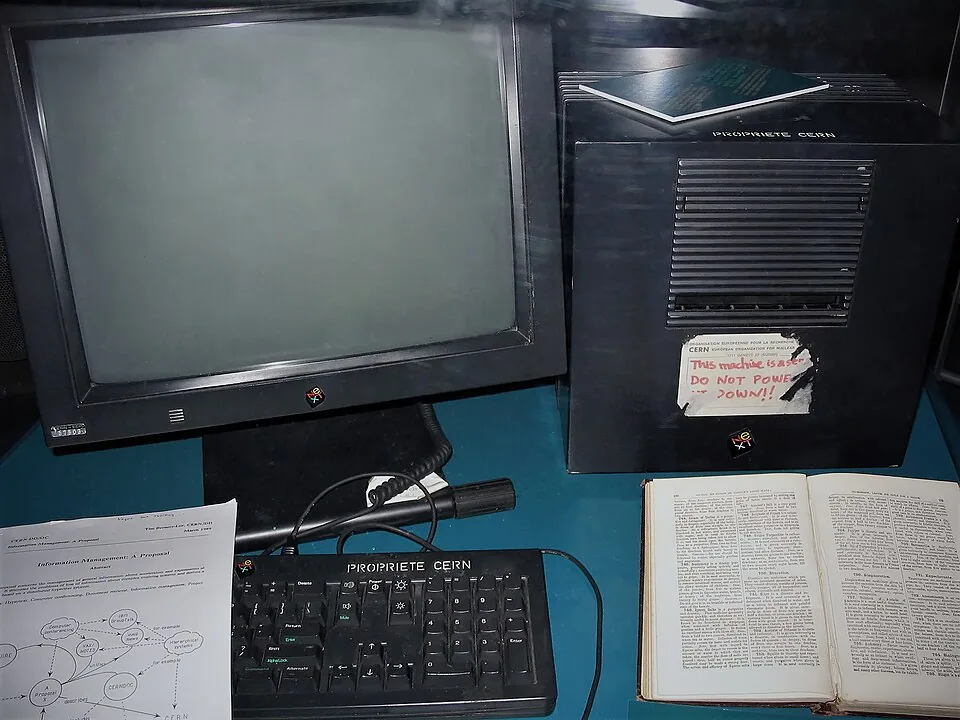
Timothy John Berners-Lee was born in London in 1955, the son of two mathematicians — Conway Berners-Lee and Mary Lee Woods — who worked on the Ferranti Mark 1, Britain's first commercial computer. A physics graduate of Queen's College, Oxford in 1976, he held several software engineering roles before joining CERN in Geneva as a consultant in 1980. There he developed ENQUIRE, a small program to manage links between documents, already grounded in the hypertext principles theorised by Ted Nelson from 1965. Back at CERN in 1984 as a permanent researcher, he submitted in March 1989 to his supervisor Mike Sendall a memo titled "Information Management : A Proposal", annotated "vague but exciting". Between 1990 and 1991, on a NeXT workstation, he wrote the three foundational components of the future Web : the HTTP protocol, the HTML markup language, and a browser-editor called WorldWideWeb. The first server, info.cern.ch, went live on 20 December 1990 ; on 6 August 1991 Berners-Lee posted a message to the alt.hypertext newsgroup announcing the project's public availability. In April 1993 CERN placed the code in the public domain — a decision crucial to global adoption. In 1994 he founded the World Wide Web Consortium (W3C) at MIT, which he has led for nearly thirty years to define open Web standards including HTML, CSS, XML and the Semantic Web stack. Knighted in 2004 by Queen Elizabeth II, he received the Turing Award in 2016 and in 2012 took part in the London Olympic opening ceremony, where he tweeted "This is for everyone". Since 2009 his World Wide Web Foundation has campaigned for free and universal access ; since 2018 the Solid project he leads at Oxford and MIT aims to return control of personal data to users. On this site Berners-Lee bridges the Internet period and the Web era, upstream of the Web 2.0 giants such as Larry Page's Google and Mark Zuckerberg's Facebook, which were both built on his invention.
1955
· UK
Tim Berners-Lee
British computer scientist, inventor of the World Wide Web