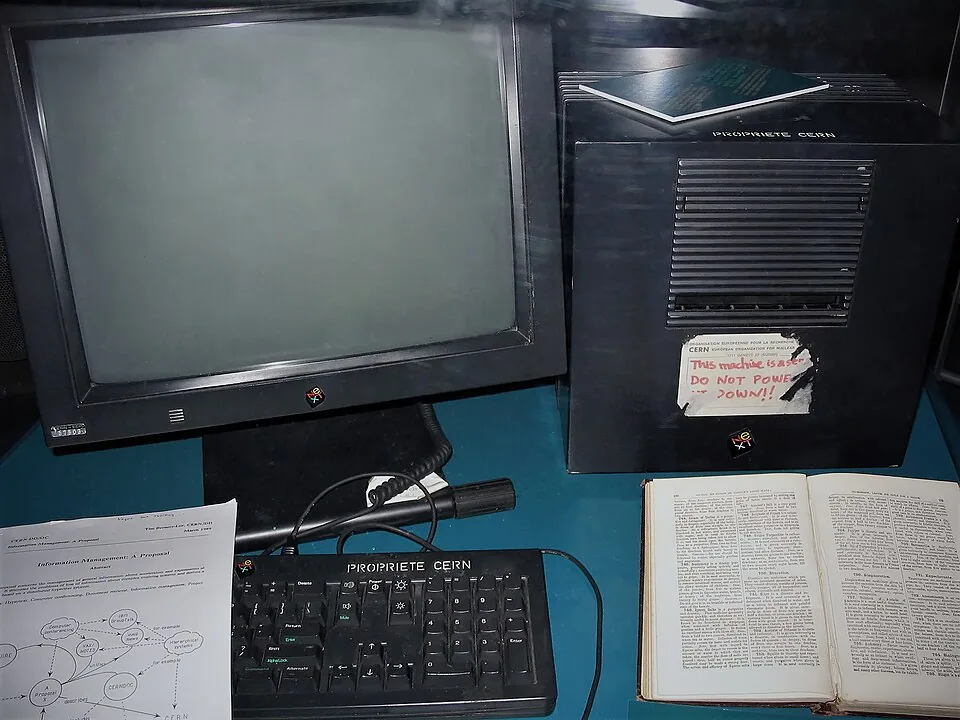
In the late 1980s, CERN — the European particle physics laboratory on the Franco-Swiss border — was one of the world's largest hubs of distributed scientific documentation. Its researchers produced a considerable mass of reports and results scattered across heterogeneous machines — VM/CMS, UNIX, VMS — that were difficult to link together. In March 1989 a British engineer named Tim Berners-Lee, soon joined by the Belgian Robert Cailliau, submitted to his superiors a memorandum entitled Information Management: A Proposal. In it he sketched a universal hypertext system built on the TCP/IP Internet stack that had been established since 1983, partly inspired by the personal Enquire software he had written at CERN in 1980. His manager Mike Sendall annotated the document with the terse "vague, but exciting". Between 1989 and 1991, Berners-Lee designed the three fundamental building blocks of the Web: the HTTP protocol (Hypertext Transfer Protocol), the HTML language (HyperText Markup Language) and the URI/URL address that identifies each resource. He wrote on a NeXT workstation the first web server and the first browser-editor, named WorldWideWeb, and set up the site info.cern.ch, the first web page in the world, whose first public version was announced on the Usenet group alt.hypertext on 6 August 1991. In April 1993, CERN relinquished all intellectual property claims on the Web and placed it in the public domain — a crucial decision for its global adoption. The Web exploded with the arrival of the Mosaic browser in 1993, then Netscape Navigator in 1994 and Internet Explorer in 1995. Berners-Lee founded the World Wide Web Consortium (W3C) at MIT that same year to standardise its evolution (HTML 4 in 1997, XML, CSS, then HTML5 in 2014). The Web transformed commerce, the press, politics and everyday life within three decades, enabling Google (1998), Wikipedia (2001), Facebook (2004) and YouTube (2005). Together with the Internet itself, it remains one of the most structuring infrastructures in human history.
1991
Software / Hypertext system
World Wide Web