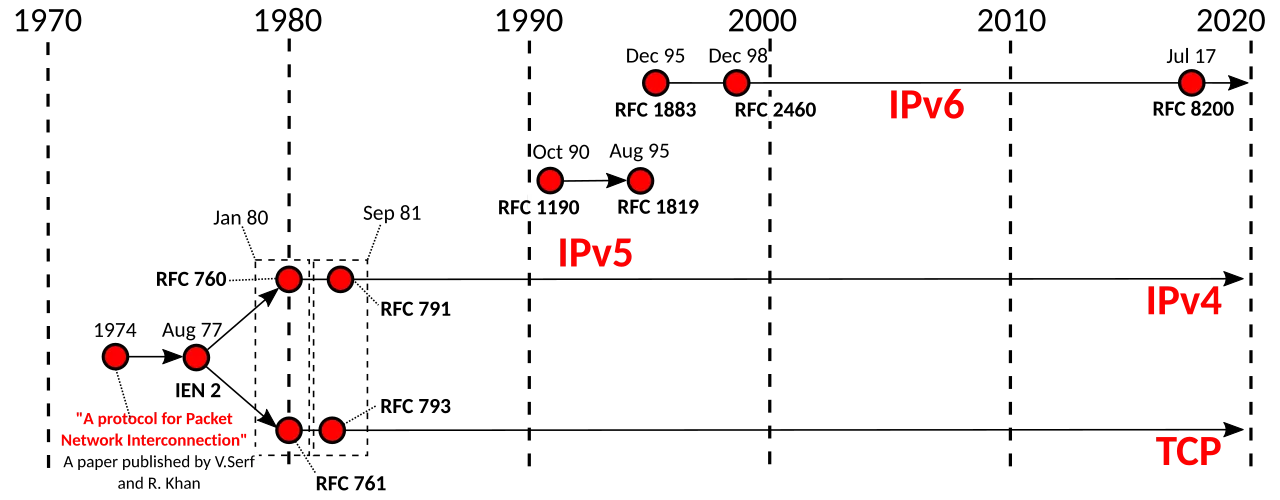
Between 1973 and 1974, Vinton Cerf and Robert Kahn, researchers working for the DARPA (Defense Advanced Research Projects Agency) of the U.S. Department of Defense, designed a protocol suite intended to succeed the NCP (Network Control Program) used by ARPANET since its creation in 1969. Their innovation addressed a fundamental challenge: how to enable transparent interconnection of heterogeneous computer networks, each operating according to its own technical standards. The two researchers published their work in May 1974 in the IEEE Transactions on Communications, in the paper "A Protocol for Packet Network Intercommunication," refined during their collaborative work at Stanford Research Institute and BBN Technologies. The TCP (Transmission Control Protocol) ensures reliable and ordered data transmission by establishing a virtual connection between two machines, while IP (Internet Protocol) manages the routing of packets across multiple and potentially incompatible networks. This two-level architecture proved revolutionary: it decomposed the network communication problem into a "transport" layer responsible for reliability and an "Internet" layer responsible for routing, allowing radically different architectures to coexist and communicate. The design was notably inspired by earlier work by Donald Davies on the packet-switching concept and by ARPANET's experience confronting its own limitations. On 1 January 1983, TCP/IP permanently replaced NCP on ARPANET, marking a decisive turning point in the history of computer networks. This transition was coordinated by the scientific community under the direction of Jon Postel, who worked at the ISI (Information Sciences Institute) and directed the RFC (Request for Comments) documentation system that became the foundation of Internet standards. From the mid-1980s, TCP/IP was established not merely as ARPANET's dominant protocol but as the technical foundation enabling worldwide interconnection of local area networks, carrier networks and academic networks that gradually merged to form the public Internet in the early 1990s. The impact of TCP/IP far exceeds the technical domain: by establishing an open, royalty-free interconnection standard, it created the foundational infrastructure for the Web, electronic mail, file sharing (FTP), remote server access (Telnet, SSH) and, later, all contemporary digital services. The TCP/IP architecture remains unchanged in its fundamental principles to this day, more than fifty years after its design, and constitutes the backbone of the worldwide Internet.
1974
Protocol / Networking
TCP/IP