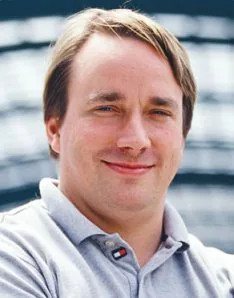
Linus Benedict Torvalds was born in Helsinki in 1969, into a family of Swedish-speaking Finnish journalists. A computing enthusiast from childhood, he learned to program on a Commodore VIC-20 given by his maternal grandfather, a statistics professor at the University of Helsinki. Reading computer science at that same university from 1988, he was frustrated by the lack of a free UNIX for his personal 386. Taking inspiration from Andrew Tanenbaum's teaching system Minix, he wrote a replacement kernel, which he announced on 25 August 1991 on the comp.os.minix Usenet group under the modest title "Just a hobby, won't be big and professional like gnu". The first public release, 0.01, appeared in September 1991. In 1992 Torvalds placed Linux under the GPL licence drafted by Richard Stallman, enabling thousands of volunteer developers to contribute. Combined with the GNU project and the Apache HTTP server, Linux became from the late 1990s the dominant foundation of web servers. It then powered supercomputing (in 2023 all 500 machines on the Top500 run Linux), embedded systems, Android phones, most cloud distributions, and the International Space Station from 2013. Torvalds has led kernel development from Portland, where he moved in 1997, employed first by Transmeta and, from 2003, by the Linux Foundation. In 2005, faced with the withdrawal of the proprietary version-control system BitKeeper, he designed Git in a few weeks ; within a decade it became the global standard, notably through GitHub, founded in 2008. Known for a direct, sometimes harsh technical leadership style, Torvalds issued a public apology for his tone in 2018 and took a temporary step back. On this site he stands at the junction between the Internet period — where Linux carried the emerging Web — and the Web era, interacting with Berners-Lee, Larry Page whose Google runs on Linux, and the free-software movement inseparable from Dennis Ritchie's work.
1969
· FI
Linus Torvalds
Finnish software engineer, creator of the Linux kernel and of Git