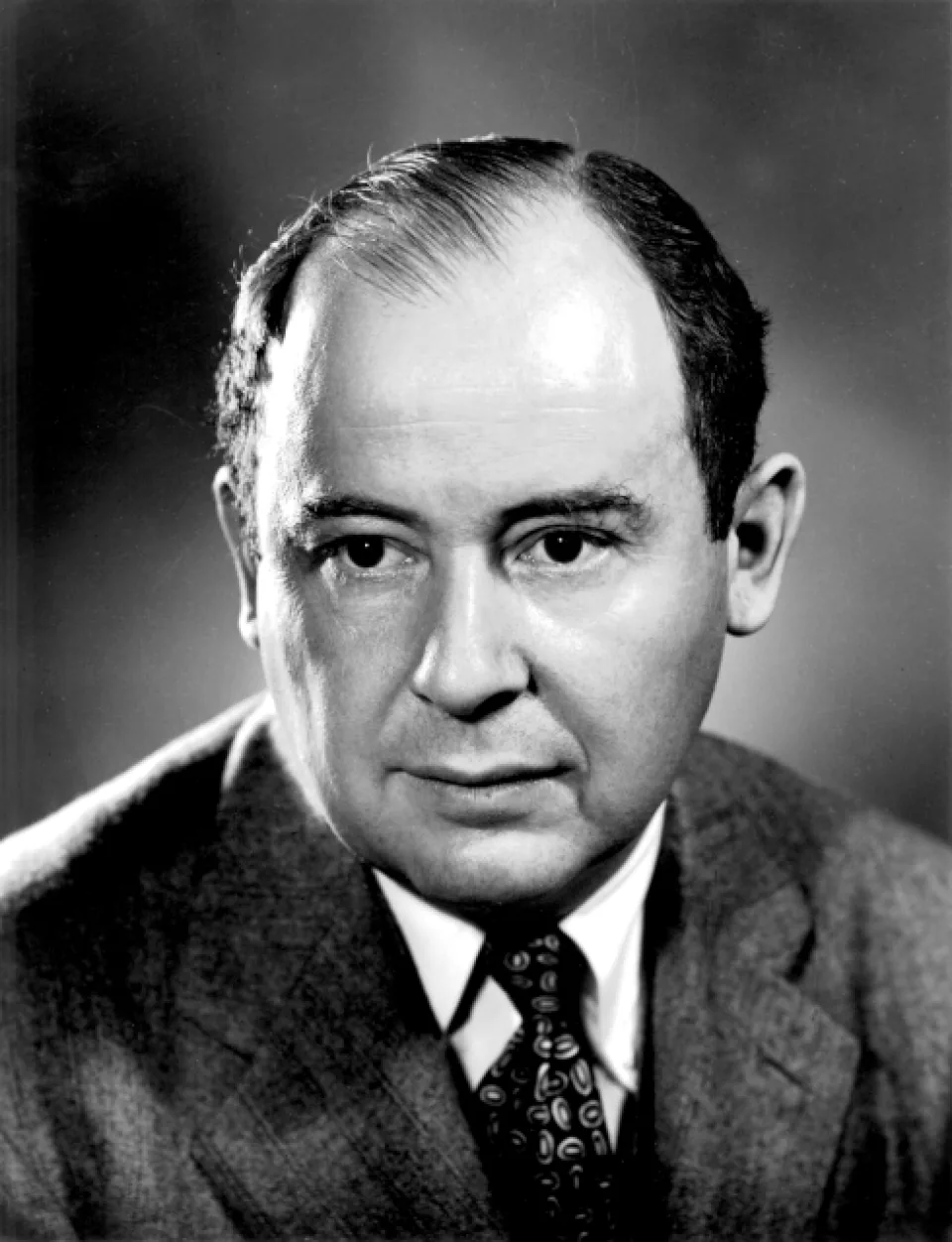
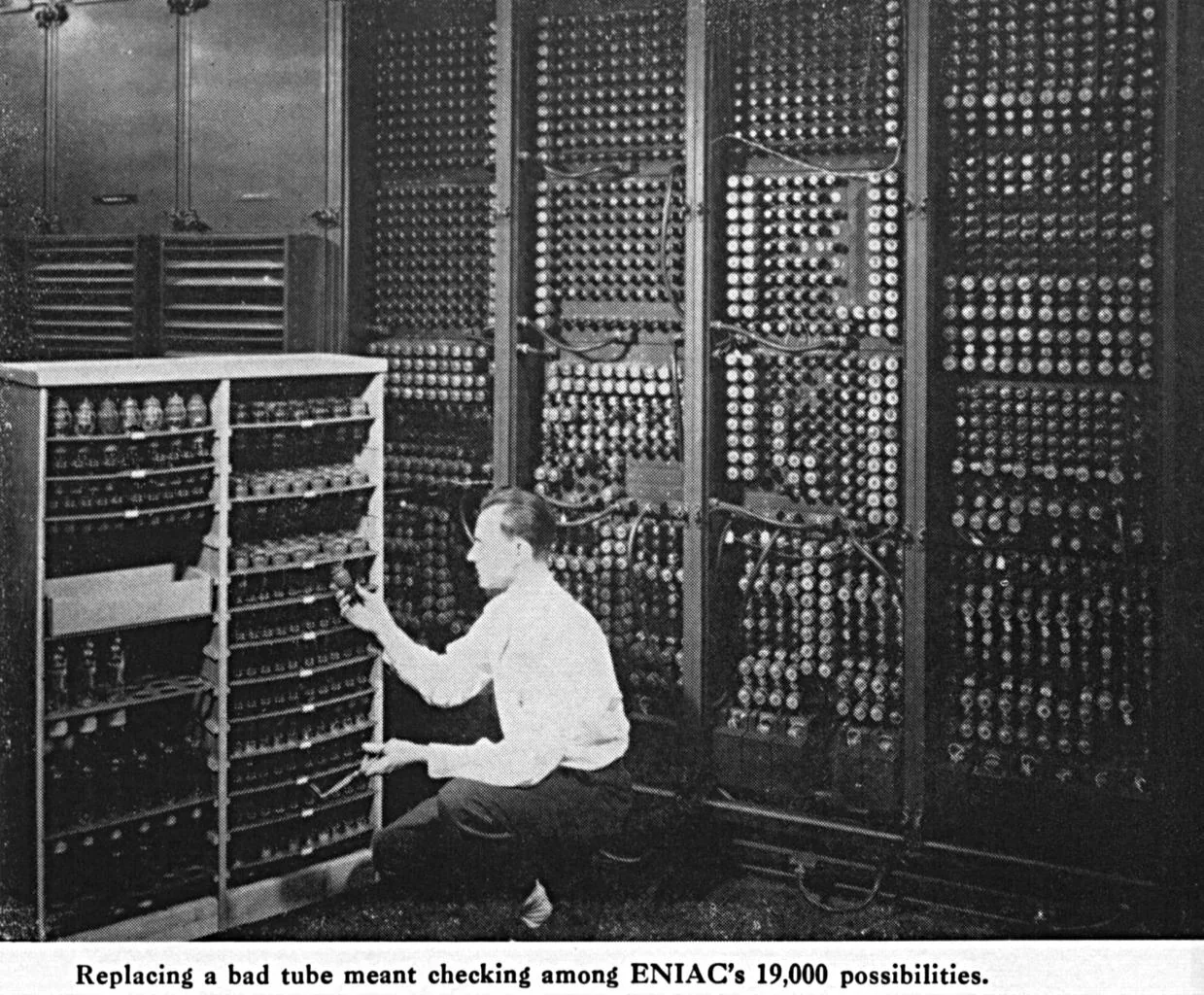
János Neumann was born in Budapest in 1903 into a wealthy Hungarian Jewish family, ennobled in 1913. A child prodigy, he spoke several languages and simultaneously pursued chemistry studies in Zurich and a mathematics doctorate in Budapest, which he defended on set theory in 1926. He taught in Berlin and Hamburg before emigrating to the United States in 1930 ; in 1933, aged 29, he became one of the six original permanent faculty of the Institute for Advanced Study in Princeton, alongside Albert Einstein. His contributions span mathematical logic, quantum mechanics, game theory (a founding work with Oskar Morgenstern in 1944) and hydrodynamics. During the Second World War he joined the Manhattan Project at Los Alamos, where his calculations on the explosive lens made the implosion bomb feasible. This need for heavy computation drew him to the ENIAC at the University of Pennsylvania, unveiled in 1945. In June 1945 he drafted the 101-page "First Draft of a Report on the EDVAC", formalising the so-called "von Neumann architecture" : a single memory holding both data and instructions, a control unit, an arithmetic unit and input-output. This model, also drawing on Turing's ideas, still structures almost every computer built today. In 1952 he led the construction of the IAS machine, which served as a template for a whole generation of calculators. Von Neumann was also a pioneer of the theory of self-replicating automata and, from the 1950s, advised the US government on nuclear weapons and ballistic missiles. Stricken with cancer, he died in Washington in 1957, aged 53. His name now designates both a machine architecture and a bottleneck (the "von Neumann bottleneck") that modern architectures strive to work around. He is one of the central figures of the electronic era traced on this site, alongside Turing, Grace Hopper and Dennis Ritchie.
1903 — 1957
· US/HU
John von Neumann
Hungarian-American mathematician, architect of the stored-program computer