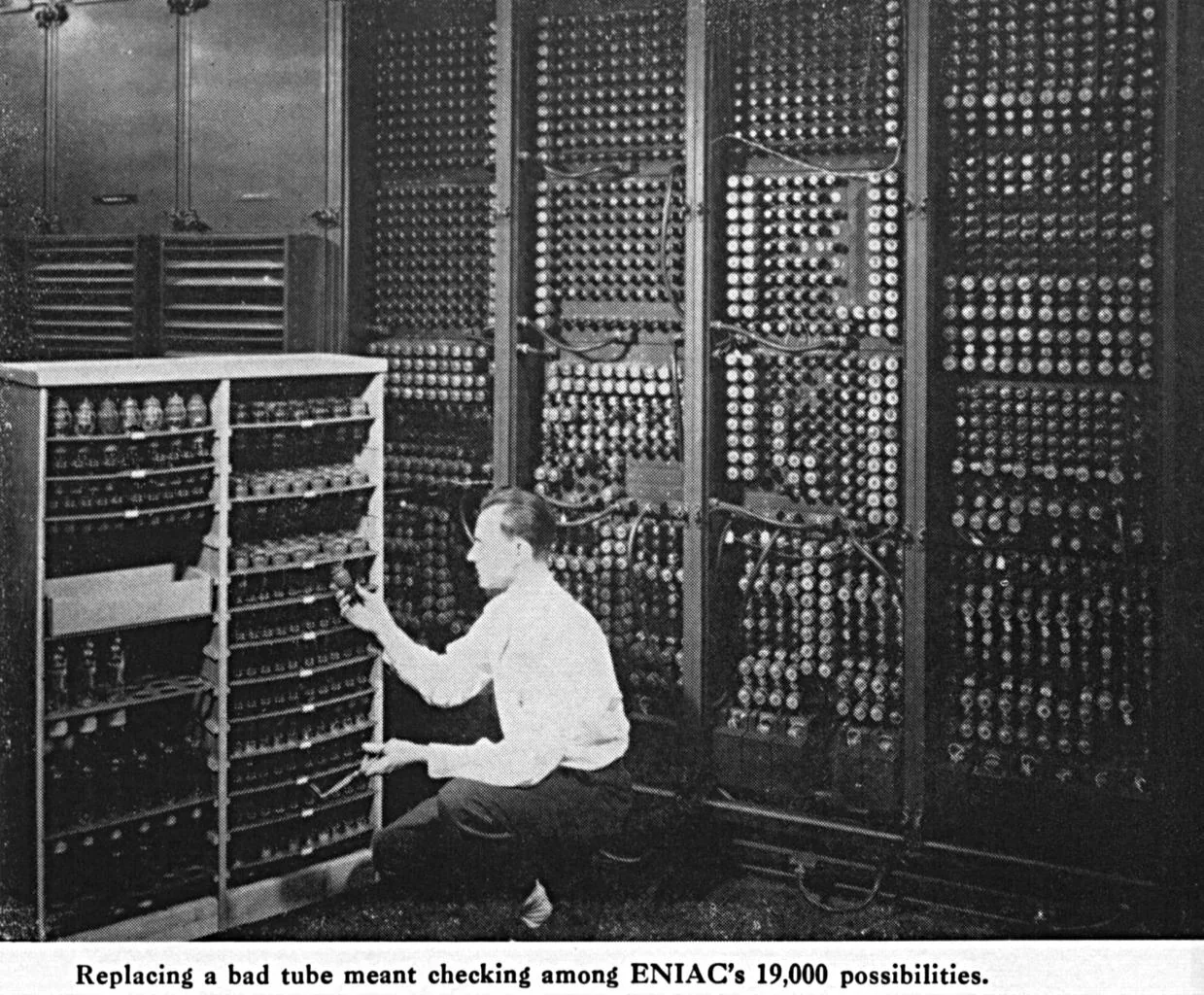
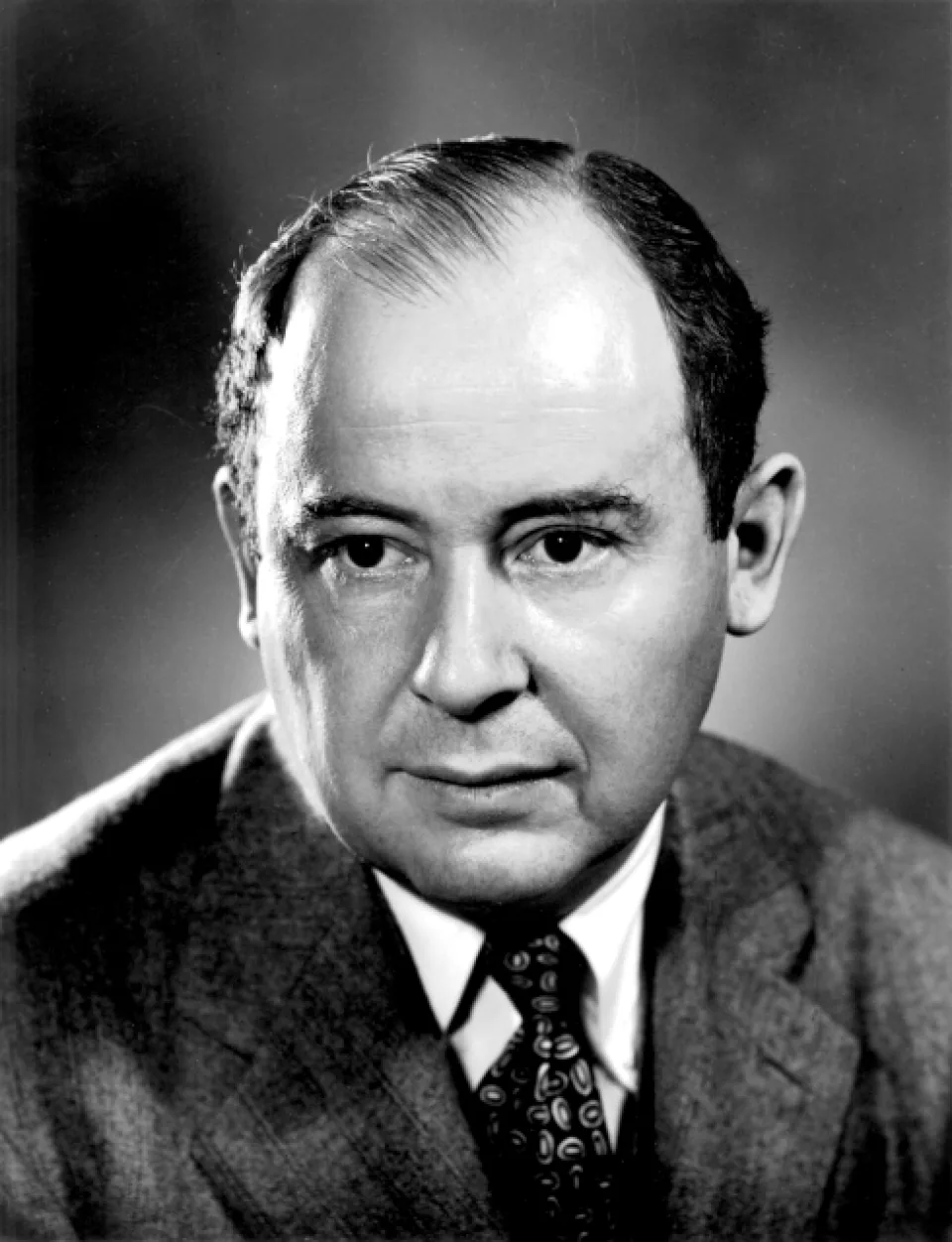
The Electronic Numerical Integrator and Computer, universally known by the acronym ENIAC, arose from the United States Army's urgent wartime need to compute artillery ballistic tables quickly. Commissioned in 1943 by the Ballistic Research Laboratory at Aberdeen, the machine was designed at the Moore School of Electrical Engineering of the University of Pennsylvania by John Mauchly and J. Presper Eckert, assisted by a team of engineers and six pioneering women programmers — Kay McNulty, Betty Jennings, Betty Snyder, Marlyn Wescoff, Fran Bilas and Ruth Lichterman — who manually configured the computations. John von Neumann joined the project as a consultant in 1944 and deeply influenced the later architecture of computing machines. Completed in 1945 and publicly unveiled on 14 February 1946, ENIAC was a monumental machine: about 17,468 vacuum tubes, 7,200 crystal diodes, 1,500 relays, 70,000 resistors and 10,000 capacitors, weighing around 27 tons and consuming 150 kilowatts. It could perform roughly 5,000 additions or 385 multiplications per second, about a thousand times faster than contemporary electromechanical calculators such as the Harvard Mark I. Fully decimal and programmed by physical rewiring and switch settings — an operation that could take several days — it carried out its first calculations in 1945 for the Los Alamos laboratory, notably simulations related to the hydrogen bomb. ENIAC operated at Aberdeen until 1955 and served as the conceptual template for an entire generation of machines. Reflection on its limitations — in particular the lack of a stored program — led von Neumann to write in 1945 the famous First Draft of a Report on the EDVAC, which formalised the so-called von Neumann architecture that underlies almost all modern computers. ENIAC thus marked the opening of the electronic era and stood as a bridge between the mechanical automata inherited from Babbage and the general-purpose computers of the following decades.
1945
Hardware / Electronic computer
ENIAC