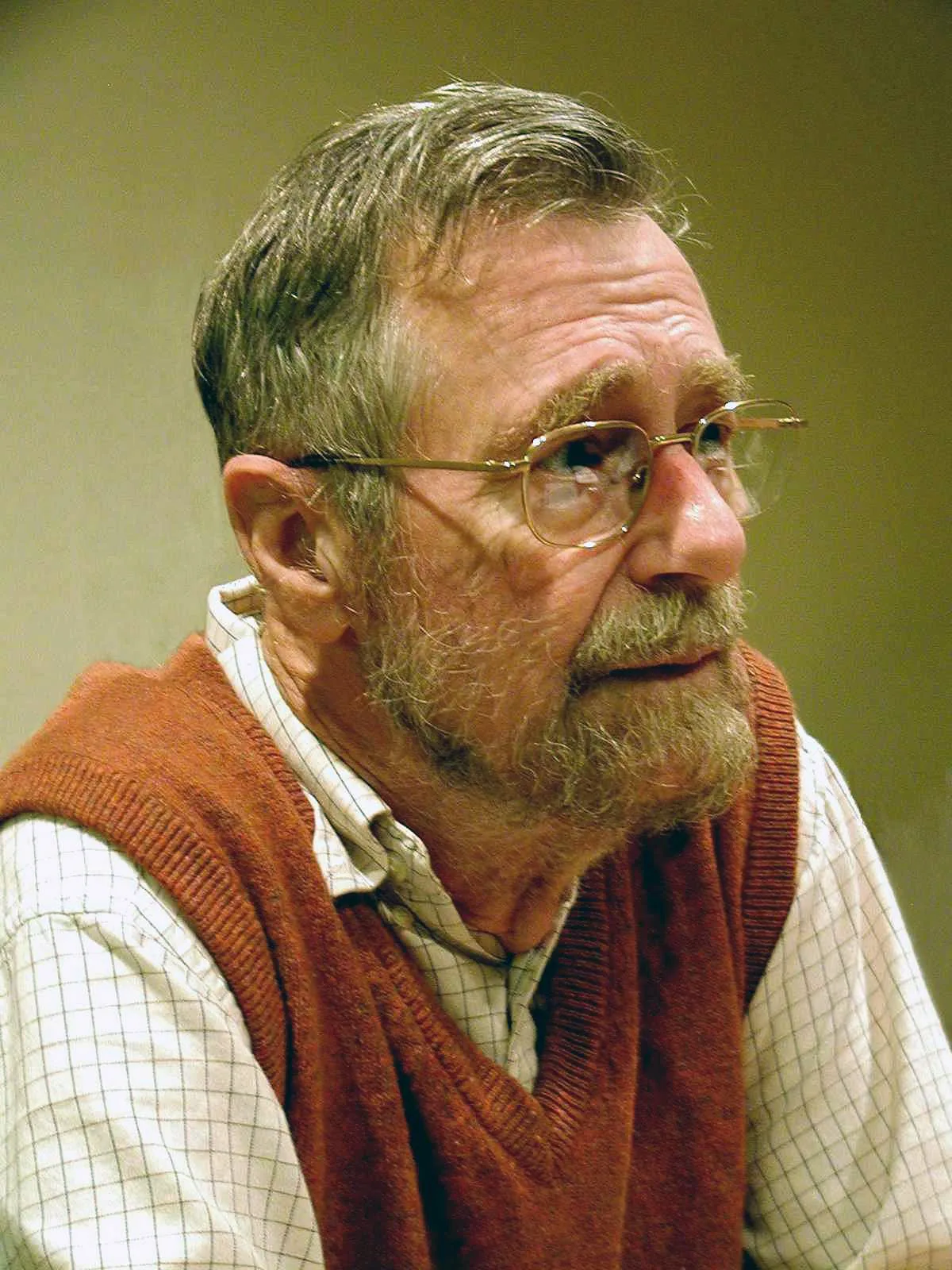
Edsger Wybe Dijkstra was born on May 11, 1930, in Rotterdam, to a family of educators. After studying mathematics and physics at Leiden University, he defended in 1959 at the University of Amsterdam a dissertation titled "Communication with an Automatic Computer" under Adriaan van Wijngaarden. In March 1952, he had become the Netherlands' first officially designated programmer at the Centrum Wiskunde & Informatica in Amsterdam, working with Bram Jan Loopstra and Carel S. Scholten on the ARMAC computer. Those years of daily practice with computing machines gave him an intimate understanding of the fundamental challenges of programming. The contribution that brought Dijkstra worldwide recognition came in 1956 at the inauguration of the ARMAC: he formulated and solved in under twenty minutes the shortest path problem in a weighted graph. Published in 1959 in Numerische Mathematik, this algorithm has carried his name ever since and remains among the most widely used in telecommunications, logistics, and digital mapping. In 1960, Dijkstra and Jaap Zonneveld developed the first compiler for ALGOL 60, preceding any competing implementation by a full year. ALGOL 60 embodied a break with the unstructured programming style dominated by GOTO instructions, and Dijkstra became its most influential advocate. Professor at Eindhoven University of Technology from 1962 to 1984, then holder of the Schlumberger Chair at the University of Texas at Austin until 1999, Dijkstra spent his career elevating computing to a rigorous scientific discipline. He invented semaphores, synchronization primitives for multitasking systems, and designed the THE operating system, a pioneer of software-paged virtual memory. His 1968 letter "Go To Statement Considered Harmful" is one of the most cited texts in computing history. Turing Award laureate in 1972, he left at his death in 2002 nearly 1,300 handwritten essays — a sustained meditation on the eternal principles of computer science.
1930 — 2002
· NL
Edsger W. Dijkstra
Dutch computer scientist who devised the shortest path algorithm, pioneered structured programming, and invented the semaphore synchronization primitive