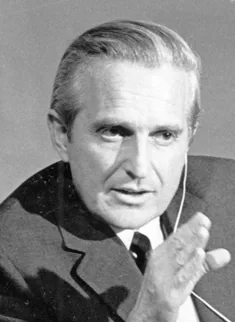
A naval radar technician during the Second World War, Douglas Carl Engelbart returned to education and earned his doctorate in electrical engineering from Berkeley in 1955. As early as 1950, after reading Vannevar Bush's article on the Memex — a hypothetical memory-augmentation machine — Engelbart gave himself a life's mission: to use the computer not as a mere calculator but as a tool for amplifying collective intelligence. He called this vision "Augmenting Human Intellect," and it shaped his entire career at the Stanford Research Institute from 1957 onward. Within the Augmentation Research Center he founded at SRI in 1963, Engelbart and his team built the oN-Line System (NLS), a revolutionary computing environment that integrated overlapping windows, word processing, hypertext, electronic mail, and video teleconferencing — all controlled by a wooden pointing device he had designed in 1963 and patented in 1967 as US Patent 3,541,541. This device, which he called an "X-Y Position Indicator for a Display System," would become the computer mouse. On December 9, 1968, in the Brooks Hall auditorium in San Francisco, Engelbart demonstrated NLS live before 1,000 engineers at the ACM/IEEE Fall Joint Computer Conference. In 90 minutes he showed, for the first time in history, a mouse, multiple overlapping windows, real-time collaborative text editing, video conferencing, and hypertext navigation. The demonstration — later nicknamed "The Mother of All Demos" — left the audience stunned. Engelbart received the Turing Award in 1997. He died on July 2, 2013, in Atherton, California, at 88, having witnessed nearly all of his inventions become the foundations of personal computing.
1925 — 2013
· USA
Douglas Engelbart
American engineer who invented the computer mouse and pioneered graphical user interfaces, hypertext, and computer-supported collaborative work