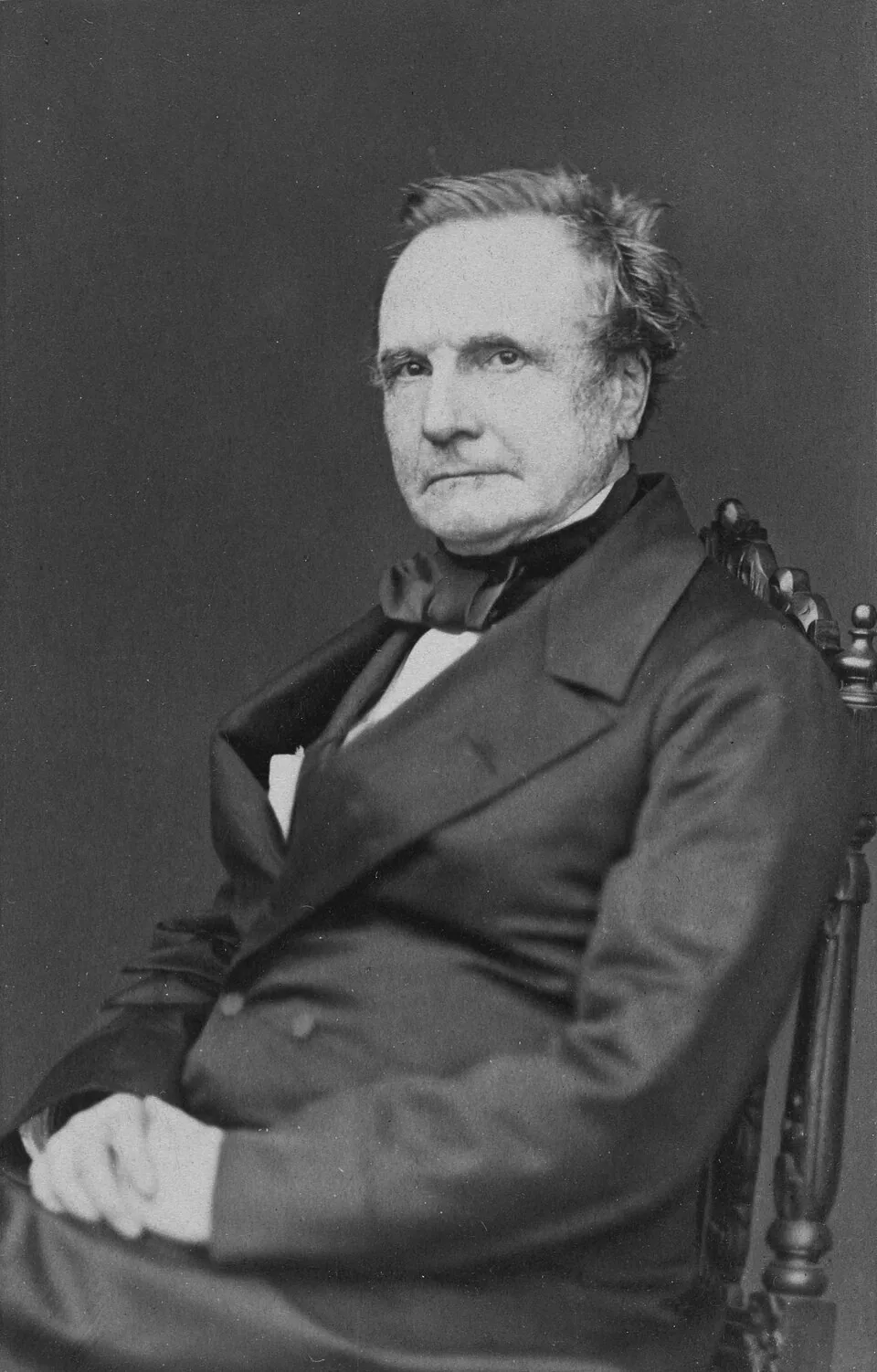
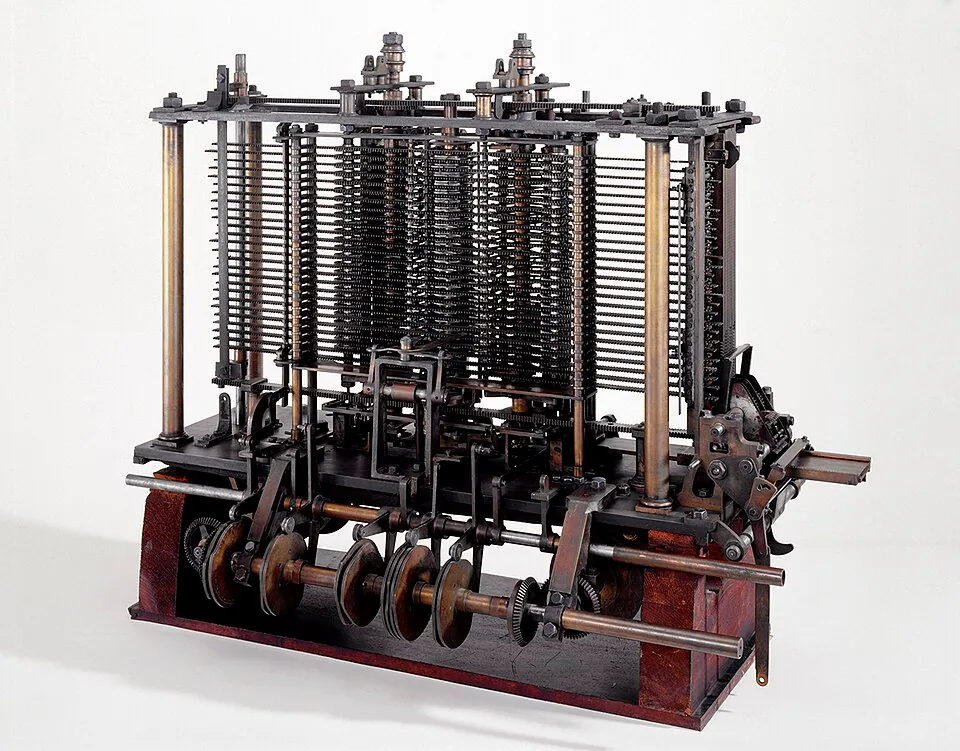
Charles Babbage was born near London in 1791 into a prosperous banking family. A brilliant student, he entered Trinity College, Cambridge in 1810, where he founded the Analytical Society with John Herschel and George Peacock to modernise British mathematics along Continental lines. Elected to the Royal Society in 1816, he became Lucasian Professor of Mathematics at Cambridge in 1828 — the chair once held by Newton and later by Hawking. A universal mind, he published on industrial economics, actuarial statistics, cryptography and even ophthalmoscopy, but mechanical calculation would absorb most of his life. Exasperated by errors in the numerical tables of his day, he designed from 1822 a Difference Engine intended to tabulate polynomial functions automatically. The British government funded the project from 1823, but the required mechanical precision exceeded the industry's capacity, construction stalled, and the project was abandoned in 1842. Babbage had, however, already moved on : in 1837 he published the description of the Analytical Engine, a punched-card machine inspired by the Jacquard loom, equipped with an arithmetic unit (the "mill"), memory (the "store") and conditional branching. This was the first architecture of a universal computer ever conceived. He worked on the project with Ada Lovelace, who formalised its programming principles between 1842 and 1843. The Analytical Engine was never completed in his lifetime, starved of funding and hampered by disputes with his engineer Joseph Clement. Babbage died in London in 1871, regarded by his contemporaries as an eccentric. His work was rediscovered in the twentieth century : London's Science Museum built a working Difference Engine No. 2 in 1991 from his original drawings, confirming the soundness of the design. Together with Ada Lovelace, Babbage opens the mechanical-origins period traced on this site, and he directly inspired the pioneers of the electronic era, from Alan Turing to John von Neumann.
1791 — 1871
· UK
Charles Babbage
British mathematician and inventor, designer of programmable calculating engines