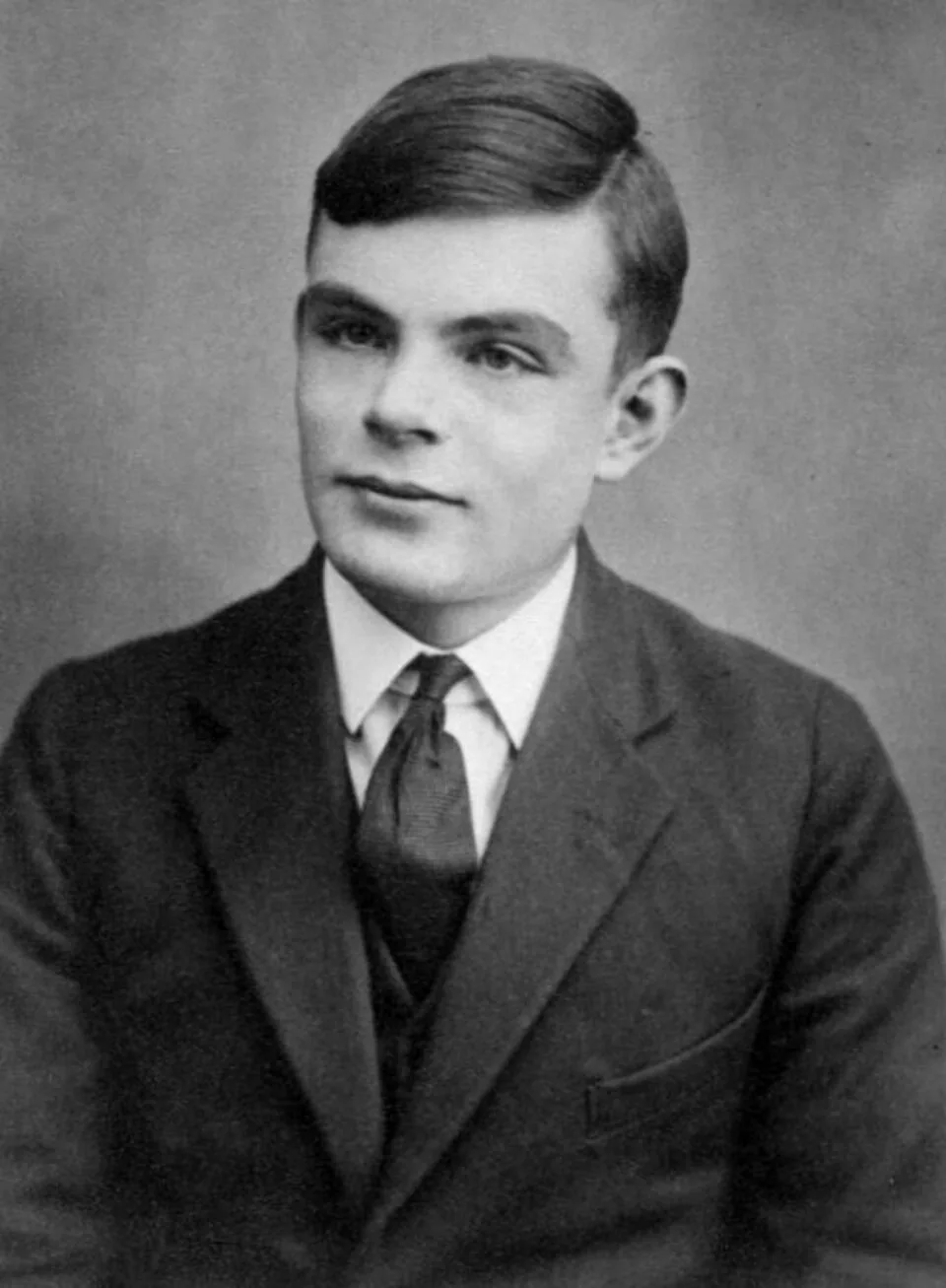
Alan Mathison Turing was born in London in 1912 into a family of Empire civil servants. A solitary but precocious pupil, he entered King's College, Cambridge in 1931 to read mathematics, and in 1938 obtained a doctorate at Princeton under Alonzo Church. His 1936 paper "On Computable Numbers, with an Application to the Entscheidungsproblem", published in the Proceedings of the London Mathematical Society, introduced the concept of a universal machine — an abstract device able to simulate any algorithm — and proved the undecidability of Hilbert's decision problem. That text laid the foundations of modern computability theory. During the Second World War, Turing joined the British codebreaking centre at Bletchley Park, where he led Hut 8, responsible for German naval signals. From 1939 he designed the "bombe", an electromechanical machine that systematically recovered Enigma's daily keys ; the historian Harry Hinsley would later estimate that this work shortened the war by at least two years. After 1945 he helped design the ACE at the National Physical Laboratory, then moved to the University of Manchester, where he contributed to programming the Manchester Mark I. In 1950 he published "Computing Machinery and Intelligence" in Mind, proposing the "imitation game" — now known as the Turing test — a founding reference of artificial intelligence. A homosexual at a time when British law criminalised it, he was convicted in 1952 and forced to undergo chemical castration. He died in 1954 of cyanide poisoning, officially ruled a suicide. The British government issued a public apology in 2009, a posthumous royal pardon in 2013, and his portrait has appeared on the fifty-pound note since 2021. Standing between Babbage and Lovelace on one side and von Neumann or Ritchie on the other, Turing is the theoretical hinge linking the mechanical origins to the electronic era traced on this site.
1912 — 1954
· UK
Alan Turing
British mathematician, theoretical founder of computer science and cryptanalyst