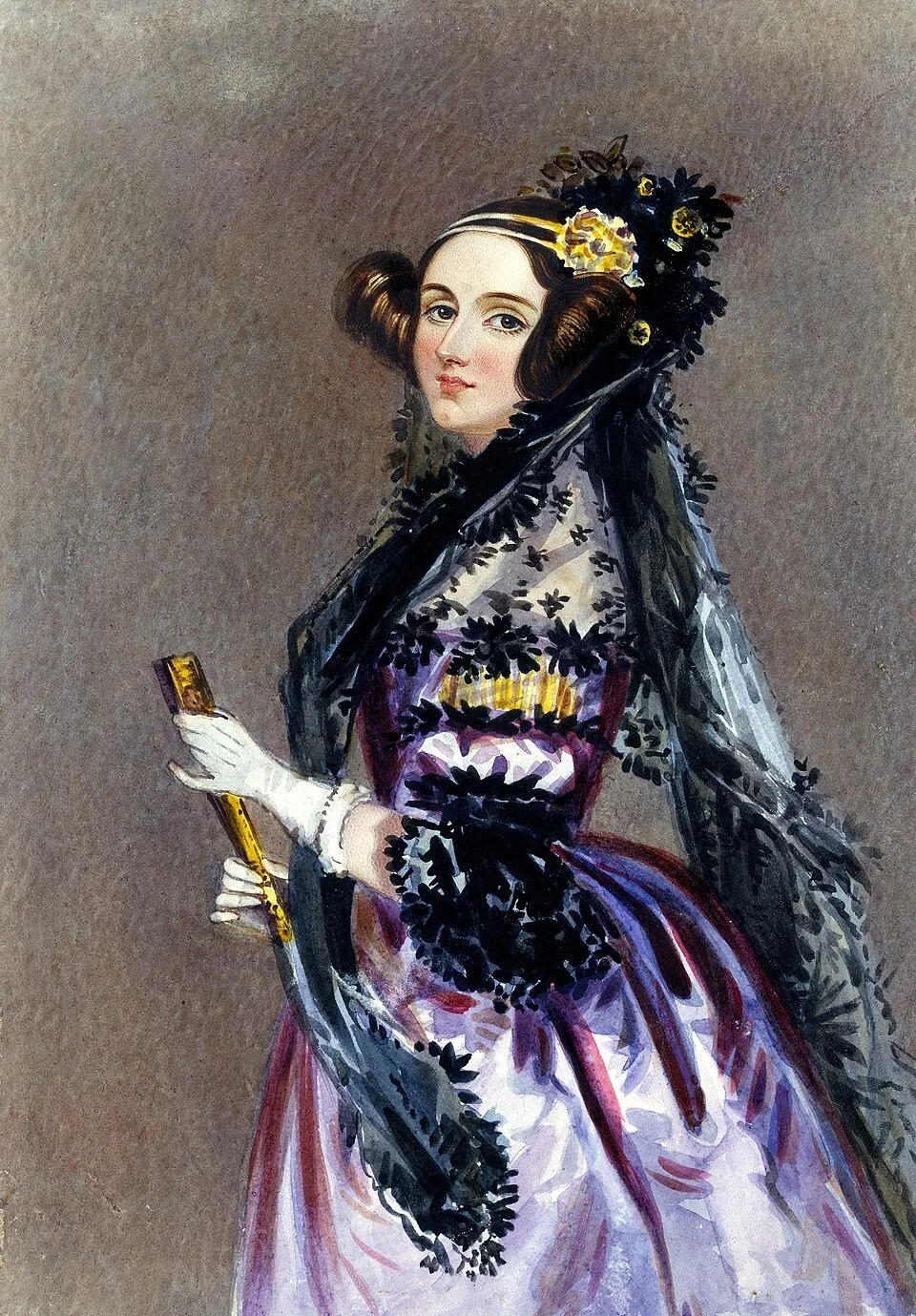
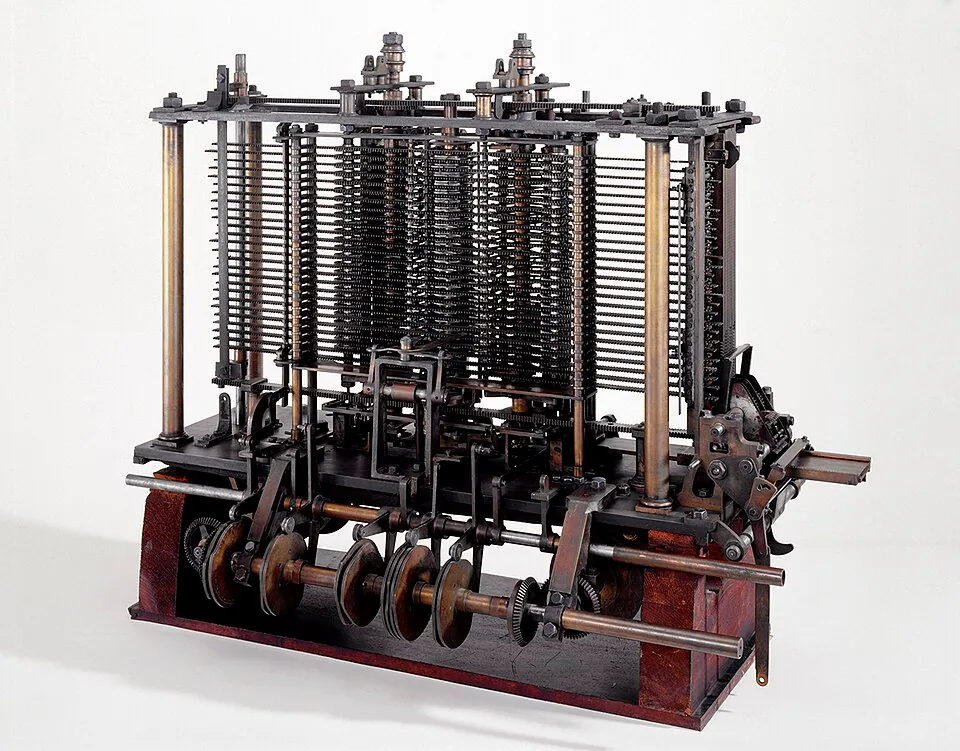
Augusta Ada King, Countess of Lovelace, was born in London in 1815, the only child of the poet Lord Byron and the mathematician Anne Isabella Milbanke. Separated from her father in infancy, she received — at her mother's insistence — an unusually rigorous scientific education for a woman of the Victorian aristocracy, under tutors including Augustus De Morgan and Mary Somerville. It was Somerville who introduced her to Charles Babbage in 1833, while he was demonstrating his Difference Engine. The young Ada was immediately captivated by the project and entered into an intellectual correspondence with Babbage that would last until her death. In 1842, Babbage delivered a lecture in Turin on his new Analytical Engine ; the Italian engineer Luigi Menabrea published a French account of it. At Charles Wheatstone's suggestion, Lovelace translated this paper into English between 1842 and 1843, adding seven notes signed "A.A.L." that were longer than the original text. The most famous, "Note G", describes step by step an algorithm designed to compute Bernoulli numbers on the Analytical Engine — widely regarded by historians as the first published computer program. Lovelace also analysed the notions of loops, variables and subroutines, and emphasised the distinction between data and instructions. Beyond the technical detail, she foresaw that because the engine manipulated abstract symbols, it could compose music or produce any result "whose rules could be formulated" — a remarkable anticipation of the general-purpose computer. After a life marked by frail health, she died in 1852, aged 36. Long dismissed as Babbage's assistant, her contribution was reassessed from the 1950s onward ; in 1980 the U.S. Department of Defense named the Ada programming language in her honour, and she is now celebrated every second Tuesday of October (Ada Lovelace Day) as a pioneering figure for women in science.
1815 — 1852
· UK
Ada Lovelace
British mathematician, pioneer of computer programming