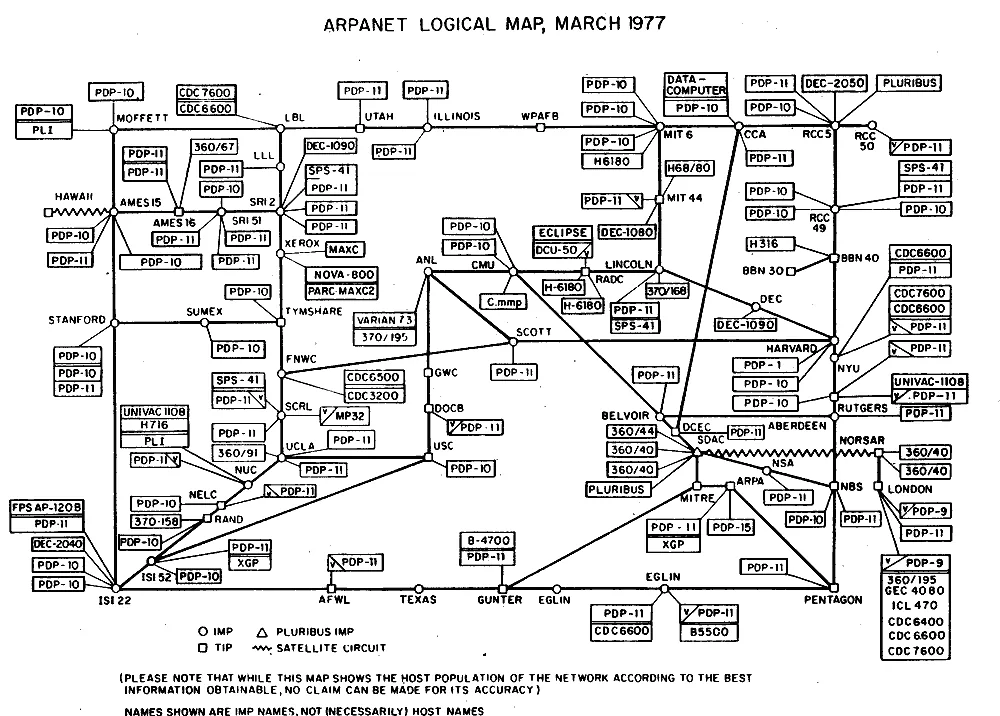
In the late 1960s, the United States Department of Defense's Advanced Research Projects Agency (ARPA) sought to pool the resources of the large computers scattered across the universities and research centres it funded. Driven by J.C.R. Licklider, then by Bob Taylor and Larry Roberts, and building on the theoretical work of Paul Baran at RAND (1964) and Donald Davies at the British National Physical Laboratory on packet switching, the ARPANET project was launched in 1968. The implementation contract was awarded in December 1968 to BBN of Cambridge, Massachusetts, which built the dedicated routers known as IMPs (Interface Message Processors). The first ARPANET message was transmitted on 29 October 1969 between UCLA and the Stanford Research Institute: Charley Kline attempted to send "LOGIN" but the connection dropped after the first two letters, delivering the famous first word of the network, "LO". By the end of 1969 four nodes were connected (UCLA, SRI, UCSB, Utah). ARPANET initially relied on the NCP (Network Control Program) protocol, replaced on 1 January 1983 by the TCP/IP suite designed from 1973 onwards by Vinton Cerf and Robert Kahn, which enabled the interconnection of heterogeneous networks. Electronic mail, invented by Ray Tomlinson in 1971 together with the now famous "@" sign, quickly became the network's dominant application. ARPANET expanded through the 1970s to dozens and then hundreds of sites, before being progressively absorbed into NSFNET from 1985 and officially decommissioned in 1990. It is the direct ancestor of the modern Internet and durably established packet switching, decentralised distribution and open standards as founding principles. The ecosystem it prefigured made possible the World Wide Web in 1991, Mosaic in 1993, Google, Wikipedia and the whole range of contemporary platforms.
1969
Network / Computer network
ARPANET