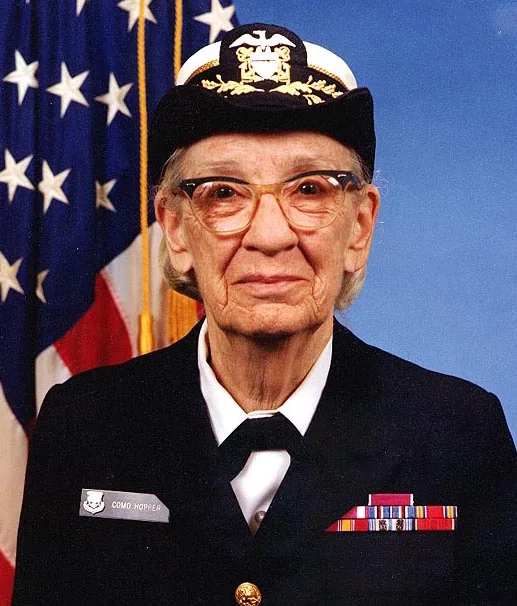
Grace Brewster Murray was born in New York in 1906 into a family where higher education for daughters was encouraged. A graduate of Vassar College in 1928, she earned a mathematics doctorate at Yale in 1934, one of the first awarded to a woman in that field. She taught at Vassar until 1943, when she enlisted in the Navy Reserve. Assigned to the Bureau of Ordnance Computation Project at Harvard, she became the third programmer of Howard Aiken's Harvard Mark I, a massive electromechanical calculator whose operating manual, which she wrote in 1946, stands as one of the earliest programming textbooks. After the war she joined Eckert-Mauchly Computer Corporation in 1949, where UNIVAC I was being built. There she developed the A-0 System in 1952, regarded as the first compiler in history, and in 1955 the FLOW-MATIC language, the first oriented towards business data processing in near-natural English. This work directly inspired the 1959 CODASYL conference, which produced the COBOL language ; Grace Hopper was one of its principal designers and remained its best-known advocate into the 1980s. She is also credited, on the Harvard Mark II in 1947, with popularising the term "bug" after a moth was found stuck in a faulty relay. Recalled to active duty several times, she retired from the United States Navy in 1986 at the rank of rear admiral, aged 79 — making her one of the oldest serving officers in US history. She died in Arlington in 1992 and received the Presidential Medal of Freedom posthumously in 2016. The guided-missile destroyer USS Hopper has borne her name since 1997. Her career links the electronic era — that of von Neumann and the ENIAC — to the software maturation of personal computing, where the successors of COBOL and compilers would become standard on Unix and on the PCs championed by Bill Gates.
1906 — 1992
· US
Grace Hopper
American computer scientist and naval officer, inventor of the compiler