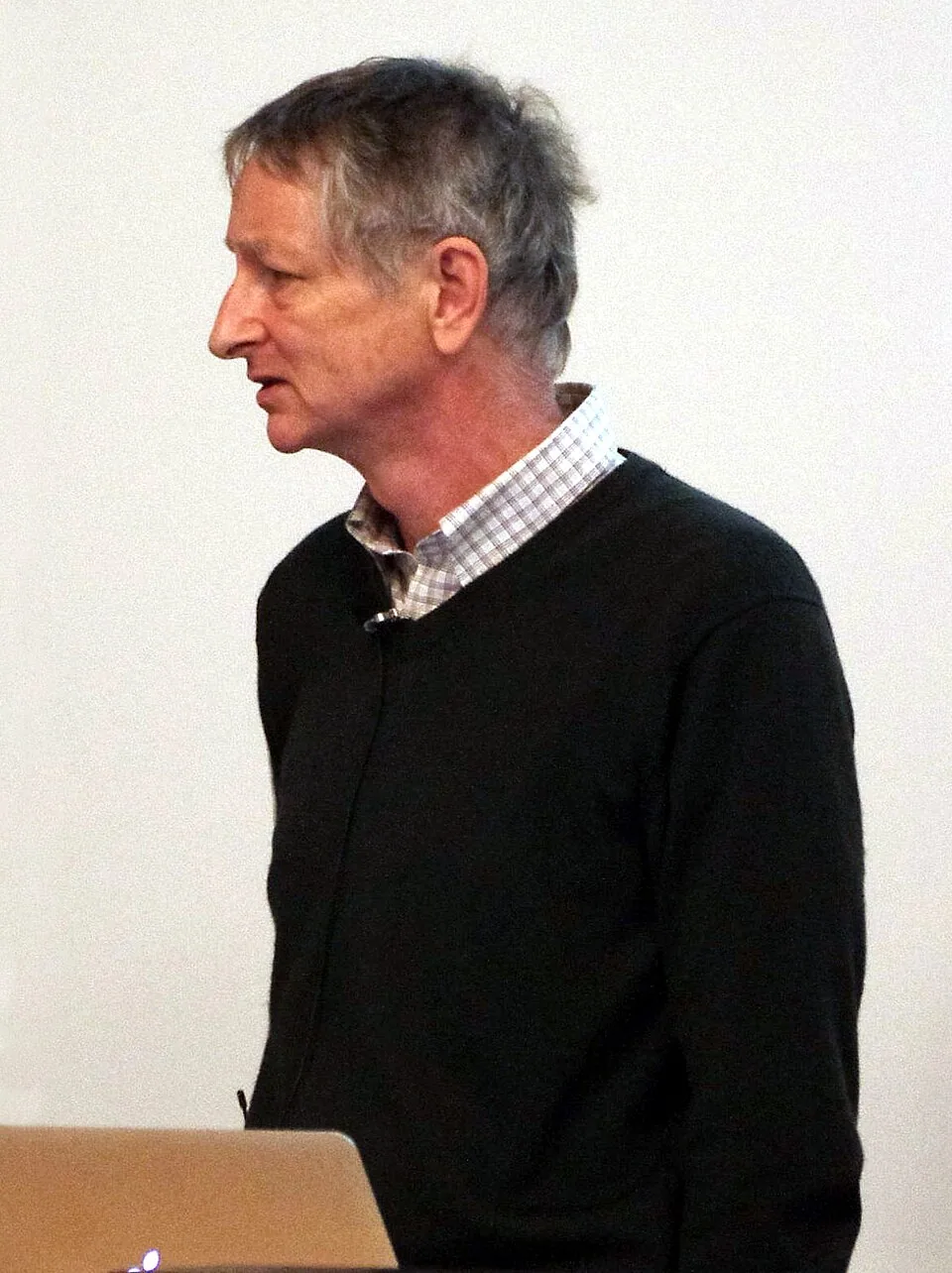
Geoffrey Everest Hinton was born in Wimbledon, England, in 1947, into a distinguished scientific family — great-great-grandson of the logician George Boole, nephew of the economist Colin Clark. After a 1970 degree in experimental psychology at Cambridge, he defended a doctoral thesis on neural networks at Edinburgh in 1978, at a time when the field was out of favour with the symbolic-AI community. He taught at Sussex, at Carnegie Mellon and, from 1987, at the University of Toronto, which became his main base despite a stint at Google Brain from 2013 to 2023. His foundational 1986 paper with David Rumelhart and Ronald Williams popularised the back-propagation algorithm for training multi-layer networks. Through the 1990s and 2000s, Hinton stubbornly kept deep-network research alive despite general disaffection. In 2006, with Simon Osindero and Yee-Whye Teh, he introduced deep belief networks, a recognised milestone of the deep-learning revival. In 2012 his students Alex Krizhevsky and Ilya Sutskever won the ImageNet competition with AlexNet by an unprecedented margin, triggering the contemporary revolution in computer vision. In 2018 he received the Turing Award with Yoshua Bengio and Yann LeCun. In May 2023 Hinton resigned from Google to speak freely about the existential risks of artificial intelligence, giving a widely reported interview to The New York Times that same month. In October 2024 he received, jointly with John Hopfield, the Nobel Prize in Physics for "foundational discoveries and inventions that enable machine learning with artificial neural networks" — the first such recognition granted to the field. He continues to teach and publish from Toronto, and co-founded the Vector Institute in 2017. On this site Hinton is the hinge between the mobile-cloud period, which provided the GPU compute and the massive data volumes required, and the generative-AI period, where his former students — among them Ilya Sutskever, co-founder of OpenAI led by Sam Altman — built the large models such as GPT-4.
1947
· UK/CA
Geoffrey Hinton
British-Canadian computer scientist, pioneer of deep neural networks