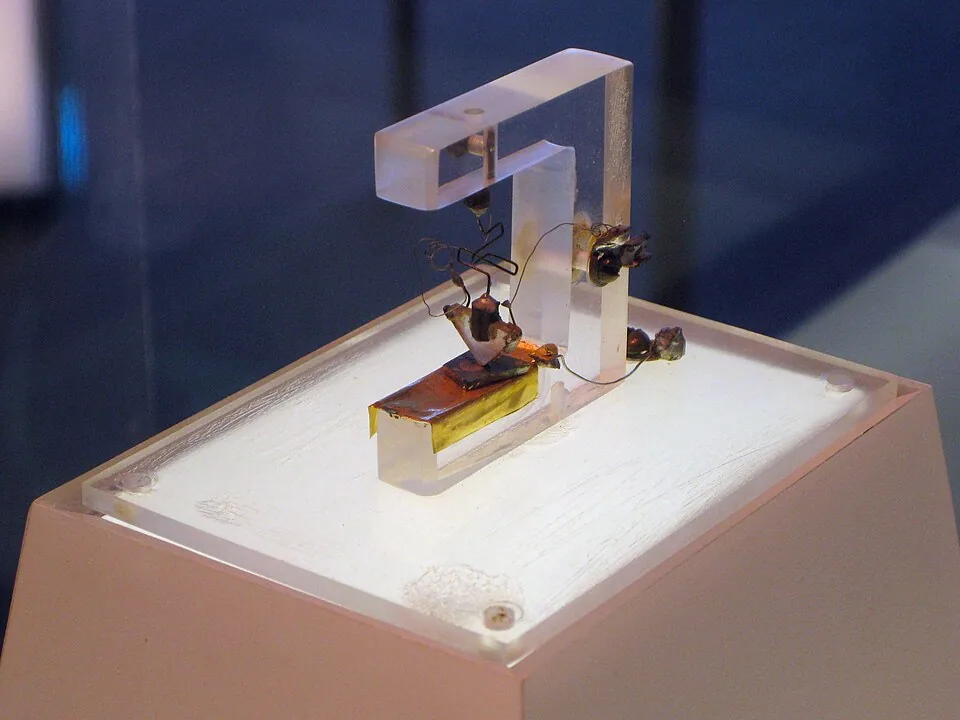
In the aftermath of the Second World War, Bell Labs in Murray Hill, New Jersey, formed a major scientific hub for American electronics. A team led by the physicist William Shockley brought together John Bardeen, a theorist of condensed matter, and Walter Brattain, a seasoned experimentalist, with the goal of replacing the vacuum tube — fragile, power-hungry and bulky. The three researchers drew on advances in semiconductor physics, notably the purification of germanium, to explore solid-state devices capable of amplifying an electrical signal. The industrial context — growing demand in telephony, radar and television — made the stakes considerable. On 16 December 1947, Bardeen and Brattain observed that a small block of germanium, fitted with two gold point contacts separated by about fifty microns, could amplify a signal by a significant factor. The device was named the point-contact transistor and was publicly presented by Bell Labs on 30 June 1948. Shockley, wanting a more robust and manufacturable device, developed in 1948 the bipolar junction transistor, far more stable, which became the basis of the industry. The three researchers received the Nobel Prize in Physics in 1956 for the discovery. The impact of the transistor has been immense. From the 1950s onwards it progressively replaced the vacuum tube in portable radios and then in second-generation computers such as the IBM 7090. In 1958, Jack Kilby at Texas Instruments and, independently, Robert Noyce at Fairchild integrated several transistors onto a single silicon wafer, giving birth to the integrated circuit, which would lead to the Intel 4004 in 1971 and then to modern microprocessors. The transistor is today the most manufactured component in human history, with trillions of units produced every year, and remains the foundational building block of all contemporary computing.
1947
Hardware / Electronic component
Transistor