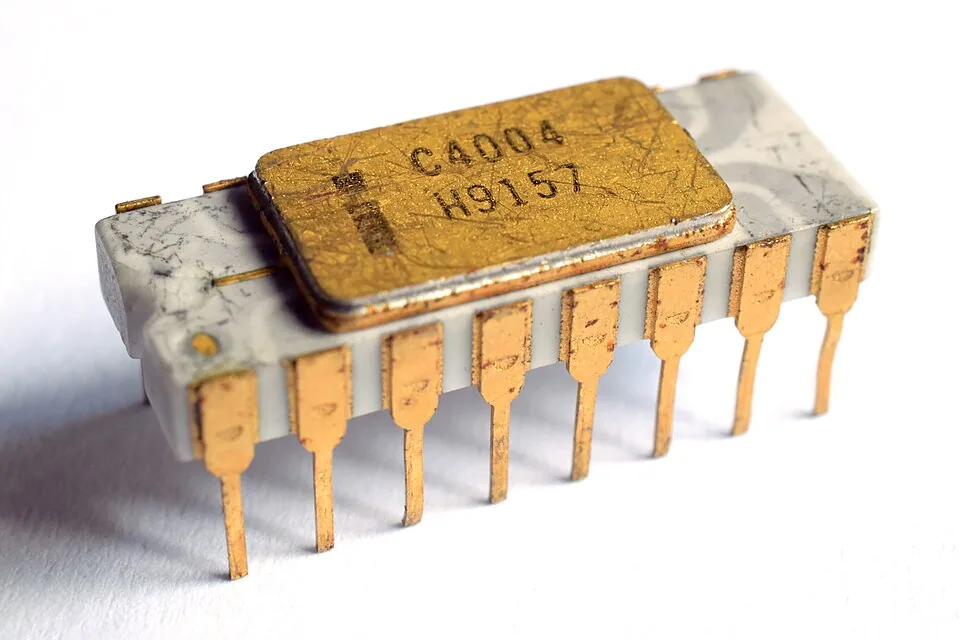
In the late 1960s, the young company Intel, founded in 1968 in Santa Clara by Gordon Moore and Robert Noyce, specialised in semiconductor memories. In 1969 the Japanese firm Busicom commissioned it to design a set of twelve integrated circuits for a programmable desktop calculator. Faced with the complexity of the request, the engineer Ted Hoff proposed a radically different approach: to combine on a single chip a programmable central unit, together with memories and interfaces. The project was carried out by Federico Faggin, who had just joined from Fairchild, supported by Stanley Mazor and by the Busicom engineer Masatoshi Shima. The circuit was designed between 1970 and 1971 using silicon-gate MOS technology. Officially released on 15 November 1971, the Intel 4004 was the first single-chip microprocessor available on the market. It packed around 2,300 transistors on a few square millimetres, with a 4-bit data bus, a clock frequency of 740 kHz and a capacity of about 92,000 instructions per second — comparable to the ENIAC twenty-five years earlier, in a sixteen-pin package. Together with the 4001 (ROM), 4002 (RAM) and 4003 (shift register) chips, it formed the MCS-4 family and made it possible to build inexpensive intelligent equipment. Intel, after acquiring the exclusive rights from Busicom in 1971 for 60,000 dollars, quickly turned it into a flagship product. The 4004 opened the way for the entire microprocessor industry: Intel 8008 in 1972, 8080 in 1974 and then the x86 family from 1978 onwards, which would dominate personal computing. It made economically viable objects previously unthinkable — calculators, industrial controllers, terminals, then microcomputers such as the Apple II (1977) and the IBM PC (1981). By democratising computation, the 4004 launched the personal computing era and stands as a milestone as important as the transistor in the technological history of the twentieth century.
1971
Hardware / Microprocessor
Intel 4004