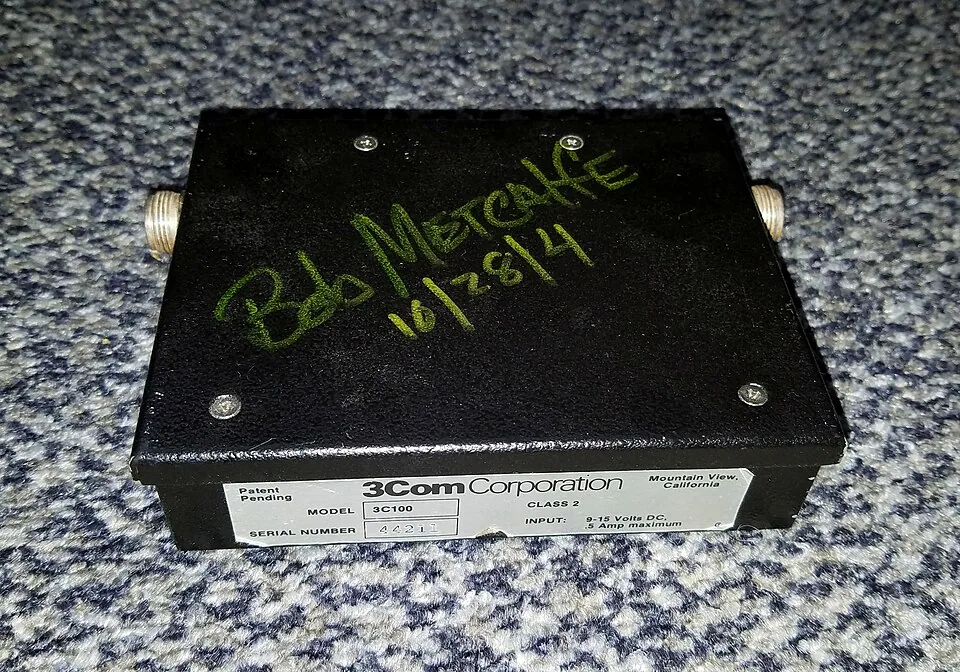
In the early 1970s, Xerox's Palo Alto Research Center (PARC), established in California in 1970, was one of the most innovative laboratories in the world. Its teams designed, among other things, the first personal computer with a graphical interface, the Alto, whose mass production required a local communication infrastructure able to connect machines, servers and laser printers. Tasked with this problem, the young engineer Robert Metcalfe, a Harvard Ph.D. recruited in 1972, drew inspiration from the ALOHAnet network developed in 1971 at the University of Hawaii by Norman Abramson, which used radio frequencies to link computers. He imagined a wired equivalent exploiting a shared coaxial cable. On 22 May 1973, Metcalfe co-wrote with David Boggs a technical memo describing a local network named Ethernet — a reference to the classical "luminiferous aether". The protocol relied on CSMA/CD (Carrier Sense Multiple Access with Collision Detection): each station listened to the cable before transmitting, detected collisions and retransmitted after a random delay. The first prototype ran at 2.94 Mbit/s. Metcalfe, Boggs, Charles Thacker and Butler Lampson filed U.S. patent 4,063,220 in 1977. In 1980, Xerox, Intel and Digital Equipment Corporation published the Ethernet 1.0 specification at 10 Mbit/s, soon standardised as IEEE 802.3 in 1983. Ethernet prevailed over competing technologies (Token Ring, ARCNET) thanks to its openness and scalability. Speeds grew by orders of magnitude: 100 Mbit/s in 1995 (Fast Ethernet), 1 Gbit/s in 1999, 10 Gbit/s in 2002, 100 Gbit/s in 2010 and 400 Gbit/s in 2017. It now forms the near-universal substrate of corporate local networks and of the data centres that run the Internet, AWS, Google and Facebook, and remains complementary to the Wi-Fi wireless technologies that emerged from the same IEEE work. Fifty years after Metcalfe's sketch, Ethernet is the most widely deployed transport technology in the world.
1973
Network / Local area protocol
Ethernet