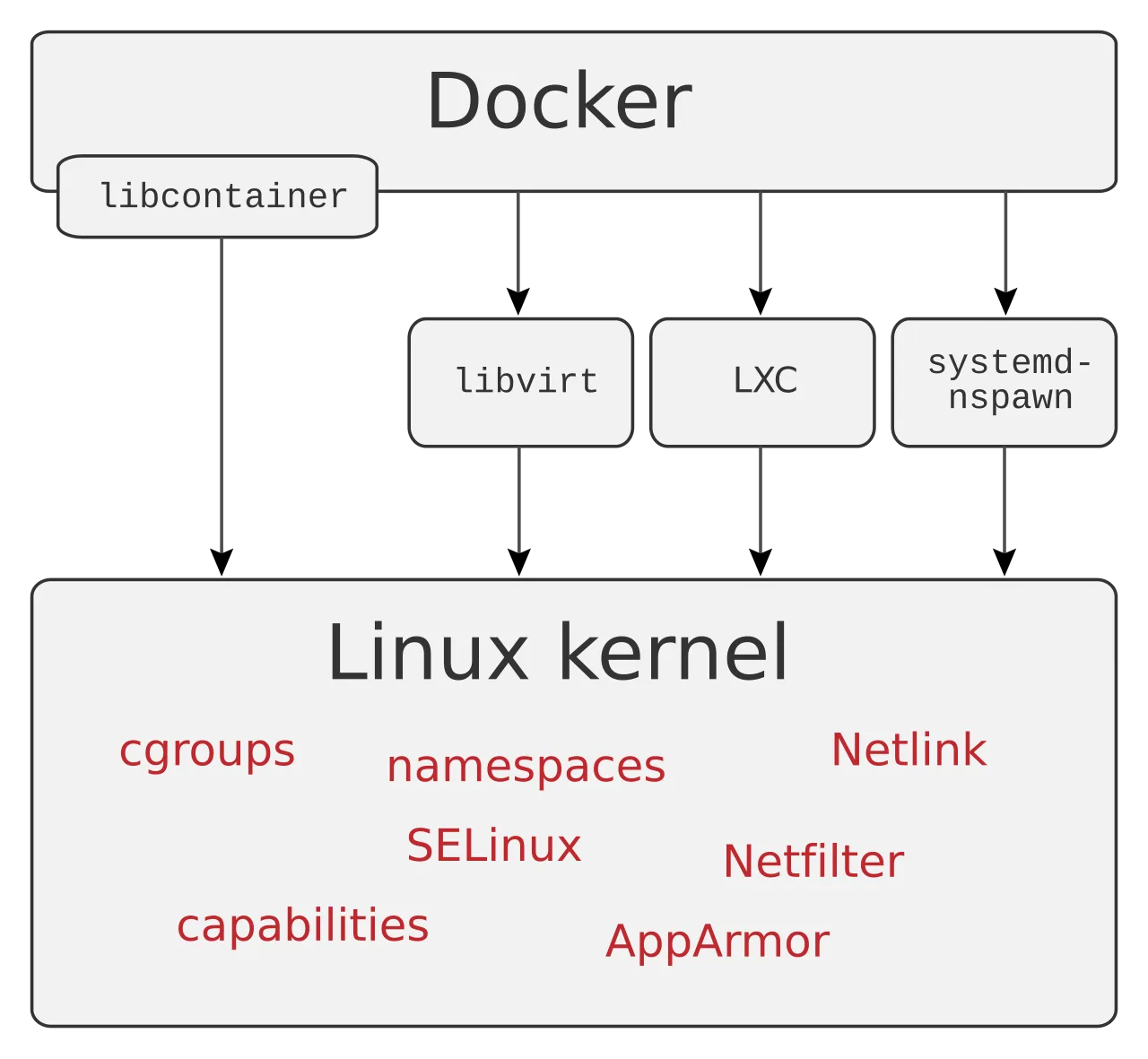
In March 2013, Solomon Hykes, founder of the dotCloud company, announced the open-source release of Docker at the PyCon conference in Santa Clara. Developed with the significant contribution of Andrea Luzzardi and François-Xavier Bourlet, Docker builds upon existing Linux technologies — notably namespaces and cgroups introduced into the Linux kernel between 2002 and 2008 — to create a lightweight and portable process isolation system. Unlike virtual machines which replicate an entire operating system, Docker containers share the host system's kernel while isolating applications and their dependencies, dramatically reducing resource overhead and startup times. The Docker platform distinguishes itself through its pragmatic approach: it encapsulates an application and all its dependencies into a containerised image, ensuring that code executes identically regardless of environment — from a developer's local machine to production cloud servers. This reproducibility eliminates the classic "it works on my machine" problem that had long plagued development teams. Docker also introduces its layered architecture, where each layer represents a modification to the image, enabling storage efficiency and differential updates. Docker's mass adoption accelerated significantly after 2014, when Docker Inc. — renamed from dotCloud — raised substantial investment and the orchestrator ecosystem began to emerge. In 2014, Google open-sourced Kubernetes, previously used internally, which became the de facto standard for large-scale container orchestration. This combination of Docker and Kubernetes fundamentally transformed application deployment practices across the industry. In the decade following its launch, Docker became the foundational infrastructure of modern cloud computing, adopted by millions of developers and integrated into major cloud services (AWS, Google Cloud, Microsoft Azure). It catalysed the widespread transition toward microservices architectures and DevOps culture, and marked a decisive inflection toward containerisation as the dominant paradigm for application deployment in the cloud era.
2013
Software / Containerization
Docker